Here you will get program to convert decimal number to roman numeral in C and C++.
How it Works?
- Divide the given number in the order 1000, 900, 500, 400, 100, 90, 50, 40, 10, 9, 5, 4, 1 to find largest base value.
- Display the corresponding roman symbol of largest base value obtained by above method in output.
- Subtract the given number with largest base value to get new number.
- Repeat above process with the new number until it becomes 0.
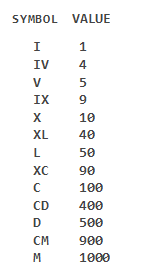
Example:
Decimal Number: 250
- Divide it in order 1000, 900, 500, 400, 100, 90, 50, 40, 10, 9, 5, 4, 1 to find largest base value. Here 250 is divided by 100. The corresponding roman symbol for 100 is C.
- Subtract 250 with 100 (largest base value in previous step) to get new number i.e. 150.
- Again divide 150 in the order mentioned earlier. It is divided by 100, so corresponding roman symbol is C.
- Subtract 150 with 100 to get new number i.e. 50.
- Divide 50 again in the order mentioned earlier. 50 is divided by 50, so corresponding roman symbol is L.
- Subtract 50 with 50. The new number obtained is 0 so we stop here.
- The final roman numeral is CCL.
Below program implements above algorithm.
Program to Convert Decimal Number to Roman Numeral in C
#include<stdio.h>

void decimal2roman(int num){
    int decimal[] = {1000,900,500,400,100,90,50,40,10,9,5,4,1}; //base values
    char *symbol[] = {"M","CM","D","CD","C","XC","L","XL","X","IX","V","IV","I"};  //roman symbols
    int i = 0;

    while(num){ //repeat process until num is not 0
        while(num/decimal[i]){  //first base value that divides num is largest base value
            printf("%s",symbol[i]);    //print roman symbol equivalent to largest base value
            num -= decimal[i];  //subtract largest base value from num
        }
        i++;    //move to next base value to divide num
    }
}

int main()
{
    printf("250 -> ");
    decimal2roman(250);

    printf("\n1550 -> ");
    decimal2roman(1550);

    printf("\n670 -> ");
    decimal2roman(670);

    return 0;
}
Output
250 -> CCL
1550 -> MDL
670 -> DCLXX
Program to Convert Decimal Number to Roman Numeral in C++
#include<iostream>

using namespace std;

void decimal2roman(int num){
    int decimal[] = {1000,900,500,400,100,90,50,40,10,9,5,4,1}; //base values
    char *symbol[] = {"M","CM","D","CD","C","XC","L","XL","X","IX","V","IV","I"};  //roman symbols
    int i = 0;

    while(num){ //repeat process until num is not 0
        while(num/decimal[i]){  //first base value that divides num is largest base value
            cout<<symbol[i];    //print roman symbol equivalent to largest base value
            num -= decimal[i];  //subtract largest base value from num
        }
        i++;    //move to next base value to divide num
    }
}

int main()
{
    cout<<"250 -> ";
    decimal2roman(250);

    cout<<"\n1550 -> ";
    decimal2roman(1550);

    cout<<"\n670 -> ";
    decimal2roman(670);

    return 0;
}
Comment below if you any queries related to above program.
The post Convert Decimal Number to Roman Numeral in C and C++ appeared first on The Crazy Programmer.
from The Crazy Programmer https://www.thecrazyprogrammer.com/2017/09/convert-decimal-number-roman-numeral-c-c.html
Comments
Post a Comment