
Difference between Process and Thread

Here you will learn about difference between process and thread i.e. process vs thread.

Process: In simple words a process is executing a program. But not all, it’s only an instance of a computing program. Several processes may be associated with the same program. Process contains program code and its current activity.

Thread: We can say thread is a light weight process. A thread of execution is the smallest sequence of programmed instructions that can be managed independently by scheduler. Threads reside inside the process. Each thread belongs to exactly one process. No thread exists outside the process.
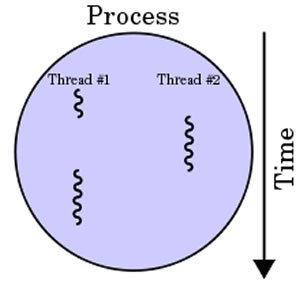
Difference between Process and Thread

Image Source

Process vs Thread – Difference between Process and Thread

Process Thread
1) System calls involved in process. 1) No system calls involved.
2) Context switching required. 2) No context switching required.
3) Different process have different copies of code and data. 3) Sharing same copy of code and data can be possible among different threads..
4) Operating system treats different process differently. 4) All user level threads treated as single task for operating system.
5) If a process got blocked, remaining process continue their work. 5) If a user level thread got blocked, all other threads get blocked since they are treated as single task to OS. (Noted: This is can be avoided in kernel level threads).
6) Processes are independent. 6) Threads exist as subsets of a process. They are dependent.
7) Process run in separate memory space. 7) Threads run in shared memory space. And use memory of process which it belong to.
8) Processes have their own program counter (PC), register set, and stack space. 8) Threads share Code section, data section, Address space with other threads.
9) Communication between processes requires some time. 9) Communication between processes requires less time than processes.
10) Processes don’t share the memory with any other process. 10) Threads share the memory with other threads of the same process
11) Process have overhead. 11) Threads have no overhead.

Threads are used for small tasks, whereas processes are used for more ‘heavyweight’ tasks – basically the execution of applications. Another difference between thread and process is that threads within the same process share the same address space, whereas different processes do not.

The post Difference between Process and Thread appeared first on The Crazy Programmer.


from The Crazy Programmer https://www.thecrazyprogrammer.com/2018/01/difference-process-thread.html

Comments

Popular posts from this blog

Rail Fence Cipher Program in C and C++[Encryption & Decryption]

Here you will get rail fence cipher program in C and C++ for encryption and decryption. It is a kind of transposition cipher which is also known as zigzag cipher. Below is an example. Here Key = 3. For encryption we write the message diagonally in zigzag form in a matrix having total rows = key and total columns = message length. Then read the matrix row wise horizontally to get encrypted message. Rail Fence Cipher Program in C #include<stdio.h> #include<string.h> void encryptMsg(char msg[], int key){ int msgLen = strlen(msg), i, j, k = -1, row = 0, col = 0; char railMatrix[key][msgLen]; for(i = 0; i < key; ++i) for(j = 0; j < msgLen; ++j) railMatrix[i][j] = '\n'; for(i = 0; i < msgLen; ++i){ railMatrix[row][col++] = msg[i]; if(row == 0 || row == key-1) k= k * (-1); row = row + k; } printf("\nEncrypted Message: "); for(i = 0; i < key; ++i) f...

Data Encryption Standard (DES) Algorithm

Data Encryption Standard is a symmetric-key algorithm for the encrypting the data. It comes under block cipher algorithm which follows Feistel structure. Here is the block diagram of Data Encryption Standard. Fig1: DES Algorithm Block Diagram [Image Source: Cryptography and Network Security Principles and Practices 4 th Ed by William Stallings] Explanation for above diagram: Each character of plain text converted into binary format. Every time we take 64 bits from that and give as input to DES algorithm, then it processed through 16 rounds and then converted to cipher text. Initial Permutation: 64 bit plain text goes under initial permutation and then given to round 1. Since initial permutation step receiving 64 bits, it contains an 1×64 matrix which contains numbers from 1 to 64 but in shuffled order. After that, we arrange our original 64 bit text in the order mentioned in that matrix. [You can see the matrix in below code] After initial permutation, 64 bit text passed throug...

Accessibility Insights for the Web and Windows makes accessibility even easier

I recently stumbled upon https://accessibilityinsights.io . There's both a Chrome/ Edge extension and a Windows app, both designed to make it easier to find and fix accessibility issues in your websites and apps. The GitHub for the Accessibility Insights extension for the web is at https://github.com/Microsoft/accessibility-insights-web and they have three trains you can get on: Canary (released continuously) Insider (on feature completion) Production (after validation in Insider) It builds on top of the Deque Axe core engine with a really fresh UI. The "FastPass" found these issues with my podcast site in seconds - which kind of makes me feel bad, but at least I know what's wrong! However, the most impressive visualization in my opinion was the Tab Stop test! See below how it draws clear numbered line segments as you Tab from element. This is a brilliant way to understand exactly how someone without a mouse would move through your site. I can easily s...