az webapp new - An Azure CLI extension to create and deploy a .NET Core or nodejs site in one command
 The Azure CLI 2.0 (Command line interface) is a clean little command line tool to query the Azure back-end APIs (which are JSON). It's easy to install and cross-platform:
- Install on Windows
- Install on macOS
- Install on Linux or Windows Subsystem for Linux (WSL)
- Run in Docker container
Once you got it installed, go "az login" and get authenticated. Also note that the most important switch (IMHO) is --output:
usage: az [-h] [--output {json,tsv,table,jsonc}] [--verbose] [--debug]
You can get json, tables (for humans), or tsv (tab separated values) for your awks and seds, and json (or the more condensed json-c).
A nice first command after "az login" is "az configure" which will walk you through a bunch of questions interactively to set up defaults.
Then I can "az noun verb" like "az webapp list" or "az vm list" and see things like this:
128→ C:\Users\scott> az webapp list

Name                      Location          State    ResourceGroup               DefaultHostName

------------------------  ----------------  -------  --------------------------  ------------------------------------------

Hanselminutes             North Central US  Running  Default-Web-NorthCentralUS  Hanselminutes.azurewebsites.net

HanselmanBandData         North Central US  Running  Default-Web-NorthCentralUS  hanselmanbanddata.azurewebsites.net

myEchoHub-WestEurope      West Europe       Running  Default-Web-WestEurope      myechohub-westeurope.azurewebsites.net

myEchoHub-SouthEastAsia   Southeast Asia    Stopped  Default-Web-SoutheastAsia   myechohub-southeastasia.azurewebsites.net
The Azure CLI supports extensions (plugins) that you can easily add, and the Azure CLI team is experimenting with a few ideas that they are implementing as extensions. "az webapp new" is one of them so I thought I'd take a look. All of this is open source and on GitHub at https://github.com/Azure/azure-cli and is discussed in the GitHub issues for azure-cli-extensions.
You can install the webapp extension with:
az extension add --name webapp
The new command "new" (I'm not sure about that name...maybe deploy? or createAndDeploy?) is basically:
az webapp new --name [app name] --location [optional Azure region name] --dryrun
Now, from a directory, I can make a little node/express app or a little .NET Core app (with "dotnet new razor" and "dotnet build") then it'll make a resource group, web app, and zip up the current folder and just deploy it. The idea being to "JUST DO IT."
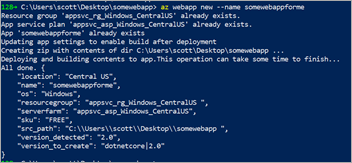
128→ C:\Users\scott\desktop\somewebapp> az webapp new  --name somewebappforme

Resource group 'appsvc_rg_Windows_CentralUS' already exists.

App service plan 'appsvc_asp_Windows_CentralUS' already exists.

App 'somewebappforme' already exists

Updating app settings to enable build after deployment

Creating zip with contents of dir C:\Users\scott\desktop\somewebapp ...

Deploying and building contents to app.This operation can take some time to finish...

All done. {

    "location": "Central US",

    "name": "somewebappforme",

    "os": "Windows",

    "resourcegroup": "appsvc_rg_Windows_CentralUS ",

    "serverfarm": "appsvc_asp_Windows_CentralUS",

    "sku": "FREE",

    "src_path": "C:\\Users\\scott\\desktop\\somewebapp ",

    "version_detected": "2.0",

    "version_to_create": "dotnetcore|2.0"

}
I'd even like it to make up a name so I could maybe "az webapp up" or even just "az up." For now it'll make a Free site by default, so you can try it without worrying about paying. If you want to upgrade or change it, upgrade either with the az command or in the Azure portal. Also the site ends at up <name>.azurewebsites.net!
DO NOTE that these extensions are living things, so you can update after installing with
az extension update --name webapp
like I just did!
Again, it's super beta/alpha, but it's an interesting experiment. Go discuss on their GitHub issues.
Sponsor: Get the latest JetBrains Rider for debugging third-party .NET code, Smart Step Into, more debugger improvements, C# Interactive, new project wizard, and formatting code in columns.
© 2017 Scott Hanselman. All rights reserved.


from Scott Hanselman's Blog http://feeds.hanselman.com/~/527978832/0/scotthanselman~az-webapp-new-An-Azure-CLI-extension-to-create-and-deploy-a-NET-Core-or-nodejs-site-in-one-command.aspx
Comments
Post a Comment