Here you will find list of best django books for beginners to learn.
If you’re eager to learn Django as it is so popular nowadays for its simplicity, then you can follow our articles that made Django more easy to learn.
But Sometimes we prefer reading offline rather than online as we’re habitual of it or maybe you think that reading online brings distraction ( for example – ads, pop-ups ). If you’re one of them who prefer reading books offline more than reading stuff online then this article is for you.
So here is the list of 5 best books for Django.
- Django for beginners (by William S. Vincent)
- Build your first website with Django 2.1 (by Nigel George)
- Django 2 Web Development Cookbook (by Jake Kronika)
- Django 2 by Example (by Antonio Mele)
- Django 2.1 Tutorial (by Hojun Lee and Suwon Choi)
Yes, you may heard a lot of other books to learn Django, they’re also good but these are the latest books available and also easy to understand. Let’s see each book in detail.
5 Best Django Books
Django for Beginners: Build websites with Python and Django
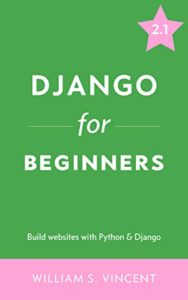
Author: William S. Vincent
Amazon: https://amzn.to/2HvPXlx
As mentioned in the name, this book is for beginners. The topics, covered in this book are:
- Basics of Django 2.1 and Python 3.7
- Using virtual environments for Django projects ( pipenv )
- Templates and URLs
- Class-based views
- User models ( Custom )
- User authentication
- Authorization
- Permissions
- Deployment and Testing
- Projects-
- A simple hello world app
- Message Board app
- A blogging app with multiple user accounts
- A newspaper app with reader comments and completer user registration
Build your first website with Django 2.1
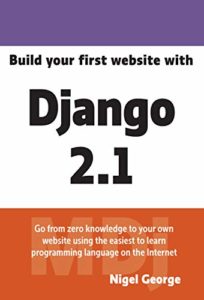
Author: Nigel George
Amazon: https://amzn.to/2QWyeCR
Again this book is based on the latest version of Django and the topics, covered in this books are:
- Why Django?
- Introduction to Python
- Structure of Django
- Models in Django
- Views in Django
- Templates in Django
- Working with admin
- Generic views
- Working with simple forms
- Working with complex forms and model forms
- Handling users
- Restricted content
- Uploading files
- How to send emails in Django?
- How to deploy?
Django 2 Web Development Cookbook
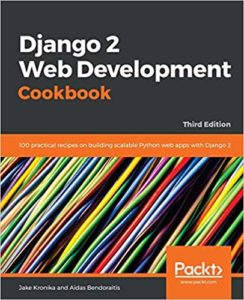
Author: Jake Kronika
Amazon: https://amzn.to/2Cw7l3J
The topics, covered in this book are:
- Basics of Django 2.1
- Structuring Database structure and modeling
- Working with forms and views
- Templates
- Working with javascript in Django
- working with Admin interface
- Security and Performance
- Django CMS
- Testing and Deployment
Django 2 by Example
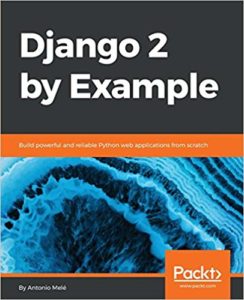
Author: Antonio Mele
Amazon: https://amzn.to/2CwuHGg
In this book, you’ll learn Django basics as well as learn how to build professional web applications with the help of 4 project examples. Antonio mele also has this course on Udemy if you ever face any problem related to this book or any topic.
Topics, covered in this book are:
- Django basics
- Working with views and templates
- Integration with other technologies such as Redis and Celery
- Develop pluggable Django applications
- using cache frameworks
- adding internationalization to your Django projects
- using JavaScript and AJAX in Django projects
- adding social features into Django projects
- Build RESTful APIs for your application
- Projects:
- Blog application
- a social image book marking website
- an online shop
- an e-learning platform
Django 2.1 Tutorial
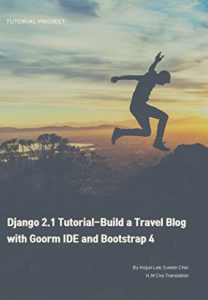
Author: Hojun Lee and Suwon Choi
Amazon: https://amzn.to/2VYa3rA
This ebook will help you to learn the basics of Django while working on a simple travel blog. So in this book, you’ll not learn Django in too much detail, but the basic stuff that is required to build a simple blog. It is a Tutorial Project.
So this was the list of books that we recommend to every beginner. Comment down below if you know about any other best book to learn django framework.
The post 5 Best Django Books for Beginners appeared first on The Crazy Programmer.
from The Crazy Programmer https://www.thecrazyprogrammer.com/2019/01/best-django-books.html
Comments
Post a Comment